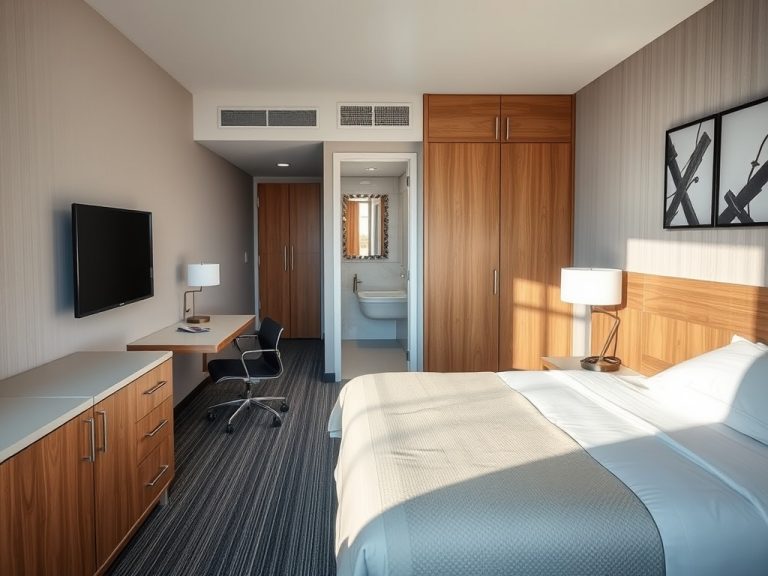
Luxury hotel interiors are not defined by marble, gold finishes, oversized lobbies, or one recognizable “expensive” style. A high-end interior can be quiet, local, minimal, historic, highly crafted, or technology-led; the more useful test is how design supports comfort, function, identity, durability, accessibility, and the property’s intended guest experience.
TL;DR
- Expensive-looking materials do not prove that an interior is well designed or luxurious.
- Comfort depends on lighting, acoustics, ergonomics, air quality, circulation, and usability as much as visual drama.
- Judge a hotel interior by how consistently design supports the stay, not by one photogenic lobby image.
What Interior Quality Can Be Verified
Design quality is partly subjective, so travelers should separate verifiable features from taste. The U.S. General Services Administration’s current buildings-and-health guidance summarizes evidence around daylight, views, acoustics, biophilic elements, and indoor environmental quality. The International WELL Building Institute likewise treats light, comfort, air, materials, and access to nature as design considerations connected to occupant well-being. Neither framework says a luxury room must look ornate.
Hotel classification offers another useful check. The current Hotelstars Union criteria include service and room requirements, but star categories are not interior-design awards. Travelers comparing five-star hotel myths should therefore avoid treating a star count as proof that a particular aesthetic will feel luxurious to them.
Myth 1: Luxury Interiors Must Use Rare or Expensive Materials Everywhere
Material cost and design quality are not the same thing. Natural stone, hardwood, custom metalwork, and handmade textiles can contribute to a premium interior, yet badly detailed expensive materials can still feel uncomfortable or impractical. Conversely, a restrained palette with durable, well-finished surfaces can feel refined when proportions, lighting, acoustics, and craftsmanship are handled carefully.
Look for evidence you can observe: solid fittings, clean transitions between materials, comfortable furniture, well-maintained surfaces, useful storage, effective blackout, and bathroom details that work. Those signals say more about how the room functions than a list of prestige materials.
Myth 2: A Dramatic Lobby Tells You What the Guest Room Will Be Like
Hotel photography naturally favors large public spaces, statement lighting, pools, and views. Those images can be accurate and still tell you little about sleep quality, outlet placement, bathroom privacy, corridor noise, or how much usable floor space the room provides. A property may invest heavily in arrival drama while guest rooms follow a much simpler design language.
This is also why the article on booking on Tuesdays recommends comparing the exact room and terms rather than reacting to a headline claim. For interiors, inspect room-specific photos and amenity descriptions instead of assuming the lobby sets the standard for every space.

Myth 3: Minimalist Design Is Automatically More Luxurious
Minimalism can feel calm and premium, but only when it serves the guest. A room with very few objects may photograph beautifully while lacking storage, task lighting, luggage space, or a comfortable place to work. Minimal surfaces can also make sound more noticeable if acoustic treatment is weak.
The opposite myth is equally shaky: decorative richness is not automatically clutter. Layered textiles, art, patterns, and local craft can create identity when they are coordinated and maintained. Luxury is better understood as intentionality and execution than as either “less” or “more.”
Myth 4: Wellness Design Is Just Plants and Spa-Like Colors
Plants and natural finishes are visible, but wellness-oriented design can also involve ventilation, glare control, daylight, acoustics, thermal comfort, accessible layouts, and materials selected with indoor air quality in mind. The GSA guidance on biophilic design points to multiple natural features and sensory conditions rather than a single decorative formula.
Technology can influence comfort too. The related discussion of AI in hotels is useful because smart controls and automated features should be judged by usability and reliability, not novelty. For wellness-oriented design, verify the physical features that matter to you instead of inferring performance from a visual theme.
Myth 5: The Most Photogenic Interior Delivers the Best Stay
A camera rewards symmetry, clean surfaces, dramatic viewpoints, and controlled lighting. Guests live with a room for hours. They notice where bags go, whether curtains truly darken the room, how easy it is to charge devices, how loud the air-conditioning is, and whether the bathroom is comfortable at night. Those details are difficult to judge from promotional images alone.
Technology can improve some functions, but it can also add friction if controls are confusing. The article on AI in hotels makes the same broader point: technology or design should be judged by the problem it solves and the reliability of the result, not by novelty.
Visual Luxury Versus Functional Luxury
| Common belief | Better rule of thumb |
|---|---|
| Premium surface finishes | Comfortable, durable materials detailed and maintained well |
| Statement lighting | Layered lighting with useful controls and limited glare |
| Large open spaces | Circulation that feels intuitive and supports privacy |
| Highly styled room photos | Room-specific evidence of storage, seating, blackout, and bathroom usability |
| Trend-driven decor | Design that fits the property, climate, culture, and expected use |
Three Details Hotel Photography Often Cannot Prove
First, a photograph cannot reliably prove acoustic comfort. A room can look serene while facing a lift lobby, nightlife, mechanical equipment, or a busy road. Second, images rarely show how lighting behaves at night: a striking pendant may not replace good bedside reading light, low-glare bathroom light, or true blackout. Third, scale is hard to judge from a wide-angle lens. A chair, luggage bench, or open bathroom layout may look generous until two people and their bags are using the room.
Treat these as questions rather than accusations. Read the room description, compare several angles, check the floor-plan information if the property provides it, and scan recent guest feedback for recurring functional themes. A single complaint is subjective; repeated comments about the same practical issue deserve more attention. For features that could determine the success of the stay, such as step-free access or a particular bathroom configuration, confirm them directly rather than extrapolating from decor photography.
Read Interior Photos Like a Guest, Not a Mood Board
When evaluating a property, move from the wide shots to the practical details. Check several images of the same room category. Look for bedside power, luggage space, seating, desk or table usability, window coverings, shower configuration, and the relationship between bedroom and bathroom. If a feature matters, verify it in the room description or with the property rather than inferring it from a photograph.
Then consider the public areas you will actually use. A memorable lobby may matter on a social trip; a quiet lounge and reliable workspace may matter more on a work trip; pool circulation may matter for a family. The right interior is the one that fits the purpose of the stay, not the one that most closely resembles a universal luxury template.
Judge Luxury by Function, Not Surface
Luxury interiors can be ornate or restrained, historic or contemporary. What separates a compelling interior from a merely expensive-looking one is the relationship between beauty and use: comfort, light, sound, circulation, maintenance, accessibility, and a coherent sense of place.
Before paying a premium for design, inspect the exact room category and identify the features that affect your stay. Treat style as a preference, verified amenities as facts, and glossy imagery as one piece of evidence rather than the whole story.
Before booking for design, identify the room features that affect comfort and verify them in the exact room category you plan to reserve.