Buying Guides & Product Comparisons | Tools/Resources | Commercial Investigation | Product-Aware | Bottom of Funnel
For a small yard, the best smart sprinkler timer is usually a controller that matches your actual number of irrigation zones, works with the existing valves and wiring, and can adjust schedules using reliable weather or soil information. Paying for far more zones or automation than the landscape needs rarely improves watering by itself.
Three current product paths stand out by use case: Rachio 3 for an app-first homeowner, Rain Bird ARC for a straightforward fixed-zone controller, and Hunter X2 with the WAND module when you want a conventional controller that can be upgraded to Hydrawise connectivity. Verify model-specific compatibility and current certification before purchase.
TL;DR
- Count active zones and identify the existing controller wiring before comparing apps.
- Look for WaterSense-labeled weather-based or soil-moisture-based control when efficiency certification matters.
- Check indoor-versus-outdoor enclosure requirements, Wi-Fi reach, manual controls, and outage behavior.
- Smart scheduling still needs correct sprinkler heads, leak-free valves, appropriate run times, and seasonal review.
Small yards still need a system-level check
A controller cannot fix broken heads, mixed precipitation rates, leaking valves, poor pressure, or zones that combine plants with very different water needs. Run every zone manually and note leaks, clogged nozzles, overspray onto pavement, and dry spots before replacing the timer.
Count the wires or labeled stations at the existing controller and confirm how many zones are actually active. A four-zone yard does not gain much from a 16-zone controller unless expansion is planned. The EPA WaterSense product search lets buyers filter certified controllers by station or zone capacity and controller type.
If connected-device maintenance is a concern, the same account-security questions apply across smart-home products. The comparison of smart locks and traditional deadbolts explains why updates, credentials, outage behavior, and vendor support belong in any connected-device purchase.
Why WaterSense is a useful filter
Weather-based controllers use local weather and landscape conditions to adjust watering schedules instead of relying only on a fixed clock. The EPA WaterSense program independently certifies qualifying weather-based controllers to performance criteria intended to meet landscape water needs without excessive irrigation.
EPA reports that replacing a standard clock-based controller with a WaterSense-labeled weather-based controller can save an average home nearly 7,600 gallons of water annually. That is a national estimate, not a promise for a particular yard. Actual savings depend on climate, prior watering behavior, landscape, equipment condition, and correct setup.
A WaterSense label is therefore a performance signal, not a guarantee that the controller is right for your wiring or plant mix. Check the exact model in EPA's current product database rather than assuming an entire brand line is certified.
Best app-first fit: Rachio 3
The current Rachio 3 Smart Sprinkler Controller is designed around app-based scheduling and control for in-ground irrigation. Rachio currently lists 8-zone and 16-zone versions on its U.S. product page, which means even the smaller standard model may exceed the needs of a very small landscape but can still suit a modest multi-zone yard.
This option is strongest for a homeowner who is comfortable configuring zones in an app and wants remote control and weather-aware automation. Before buying, confirm Wi-Fi signal at the installation point and whether an outdoor installation requires a compatible enclosure for the exact version.
The trade-off is reliance on a connected ecosystem. Keep the account secure, update the app and controller, and understand what manual control remains available if internet service is down.
Best straightforward fixed-zone path: Rain Bird ARC
The Rain Bird ARC Series includes smart irrigation controllers with app control, and Rain Bird currently offers different station counts and indoor or indoor/outdoor configurations. That range can be useful for small yards because it lets buyers choose closer to the actual zone count instead of automatically oversizing.
ARC is a practical direction for homeowners who want familiar irrigation hardware plus mobile control. Compare the exact station capacity, enclosure rating, sensor compatibility, and weather-adjustment features of the specific ARC model sold in your market.
If a contractor already services Rain Bird equipment in your area, parts familiarity and support may also be relevant. That is a local-service consideration, not evidence that the brand is universally better.
Best upgrade path: Hunter X2 with WAND
Hunter's WAND module adds Wi-Fi and Hydrawise management to compatible X2 controllers. Hunter describes predictive schedule adjustments using forecast factors such as temperature, rainfall probability, wind, and humidity. This modular approach can appeal to homeowners who like conventional controller operation but want connected management.
The key question is compatibility. Verify the exact X2 model, zone count, WAND support, and installation requirements rather than assuming any Hunter timer can accept the module. If you already own a compatible X2, the add-on path may avoid replacing the entire controller.
A small-yard shortlist by situation
Choose Rachio 3 when an app-first interface, remote changes, and a polished connected experience are high priorities, and the available zone count fits your system.
Choose Rain Bird ARC when you want a more traditional irrigation-controller form factor with smart control and prefer a station count close to a compact yard's needs.
Choose Hunter X2 plus WAND when modularity matters, especially if a compatible X2 is already installed or you want the option to use a conventional controller with an added smart layer.
If your "small yard" is actually one hose-fed bed or patio zone rather than an in-ground multi-valve system, a smart hose timer may be a better category entirely. Do not buy an in-ground controller for plumbing it cannot operate.
| Use case | Product direction | Why it fits |
|---|---|---|
| App-first homeowner | Rachio 3 | Remote app control and weather-aware scheduling |
| Compact fixed-zone system | Rain Bird ARC | Multiple station-count and enclosure options |
| Modular upgrade path | Hunter X2 + WAND | Adds Hydrawise connectivity to compatible X2 hardware |
Installation and setup details that change results
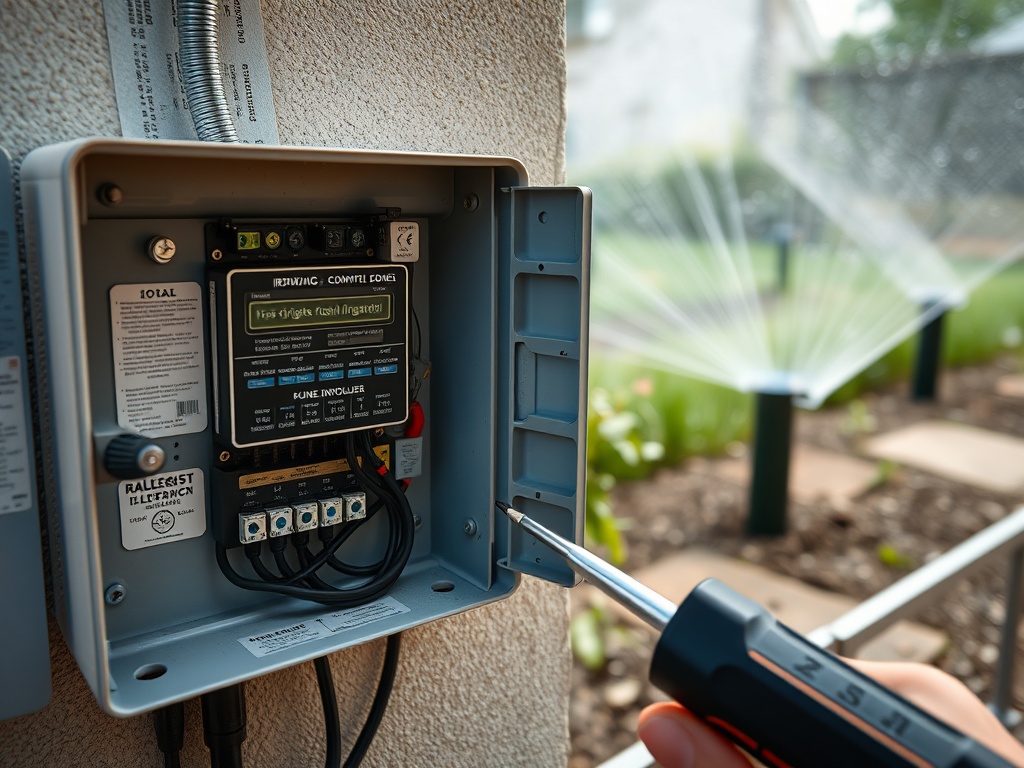
Turn off power to the controller before handling line-voltage components and follow the manufacturer's instructions. Many irrigation controllers use low-voltage valve wiring, but the transformer or supply connection still requires electrical care. Outdoor locations need equipment rated or enclosed for that environment.
Name zones by what they water, not only by number. Record plant type, sun exposure, sprinkler type, soil behavior, and slope. Smart scheduling depends on these inputs being reasonably accurate. If a lawn rotor zone and drip-irrigated shrubs share one valve, no controller can independently optimize them.
Run a short test after setup and observe every sprinkler. Correct overspray, leaks, stuck valves, and blocked heads. Automation is most useful after basic hardware performs properly.
Maintenance after the novelty wears off
Review schedules at seasonal transitions and after landscape changes. A controller may adjust for weather, but it does not know that you removed turf, added a drought-tolerant bed, changed emitters, or capped a head unless you update the zone settings.
Check app notifications and firmware periodically. If the controller exposes an account to the internet, use unique credentials and multi-factor authentication when offered. Save installation notes and wire labels so another household member or irrigation technician can operate the system without reconstructing the setup.
Keep the controller area uncluttered and dry. A utility cart may organize nearby hand tools, but follow the load and moisture guidance in the rolling-cart comparison rather than parking storage against electrical or irrigation equipment. Likewise, basic decluttering principles from the clutter-free living-room guide translate well to utility spaces: every tool needs a home, but access panels and wiring need clear space.
Buy for the zones you have
A small yard rarely needs the most feature-heavy controller on the market. Start with active zone count, wiring, enclosure location, Wi-Fi availability, and the watering problem you want automation to solve.
Check the exact candidate model in the current WaterSense database and manufacturer documentation, then choose the controller whose capacity and maintenance demands fit your landscape rather than the one with the longest feature list.
General information note: Irrigation, water-efficiency, electrical, and product guidance is general and educational. Local watering restrictions, rebates, wiring, plumbing, certification status, and product specifications vary; verify current rules and manufacturer instructions for your installation.