
Kitchen, Bath & Storage Planning | How-To | Informational | Intermediate | Top of Funnel
A fast-access linen closet works when its most-used items are visible, grouped by purpose, and stored at the height where they are easiest to reach. The best layout is usually simple: daily towels and sheet sets in the prime zone, backups higher or lower, and household chemicals separated and secured where necessary.
The organizing goal is retrieval, not display. A closet that looks neat but requires unstacking six piles to reach one fitted sheet will be difficult to maintain.
TL;DR
- Empty the closet, sort by household use, and measure shelves before selecting containers.
- Give the most frequently used items the easiest reach and keep each category within a defined shelf zone.
- Bundle sheet sets, limit deep stacks, and use labels only where they reduce searching.
- Separate cleaners, medicines, and hazardous household products from linens and keep them secured from children.
Prepare the closet before sorting back in
Remove everything so you can see shelf depth, vertical spacing, door clearance, and awkward corners. Vacuum shelves and wipe them with a material-appropriate cleaner, allowing the area to dry fully before returning fabric. Moisture trapped around linens can create odors and may encourage microbial growth.
As you empty the closet, separate damaged towels, incomplete sheet sets, items for donation, and anything that actually belongs elsewhere. Do not use the closet as a holding area for unrelated household overflow. If the living room is absorbing spare throws or cleaning supplies because the closet is overloaded, the broader method in maintaining a clutter-free living room can help you decide what should live in each space.
Measure every shelf. Record width, usable depth, and height between shelves, plus the narrowest part of the door opening. Storage bins that technically fit the shelf but cannot clear the door frame are a common frustration.
Create categories based on retrieval, not appearance
Sort by how the household searches. For many homes, that means bath towels, hand towels, washcloths, primary-bed sheets, guest sheets, blankets, and table linens. Another household may prefer one shelf per bedroom or bathroom. Either system can work if the person looking for an item can predict where it will be.
Keep categories broad enough to maintain. If every towel size has a separate bin but family members routinely mix them, the system is too fussy. If all linens share one deep shelf and items disappear at the back, the system is too loose. The useful middle ground is a small number of clear zones.
Before buying bins, test the zones with folded stacks or temporary cardboard dividers for a week. This reveals which categories expand, which rarely get touched, and which need a different location.
Put high-frequency items in the prime zone
The prime zone is usually between about waist and eye level for the main user, but accessibility needs vary. Put daily bath towels and the sheet sets changed most often there. Reserve the highest shelves for light, infrequently used items such as seasonal blankets. Lower shelves can hold heavier baskets if bending is comfortable and safe for the user.
Avoid creating tall unstable towers. Shorter stacks are easier to remove from without collapsing the rest. Shelf dividers can keep stacks vertical, while open-front bins can contain small items without requiring a lid to be removed each time.
If your storage needs shift between rooms, a rolling cart can handle active supplies, but it should not become a substitute for fixing an overfilled closet. Use mobility for items that genuinely move, not for categories that simply lack a defined home.
Use a sheet-set method you can repeat
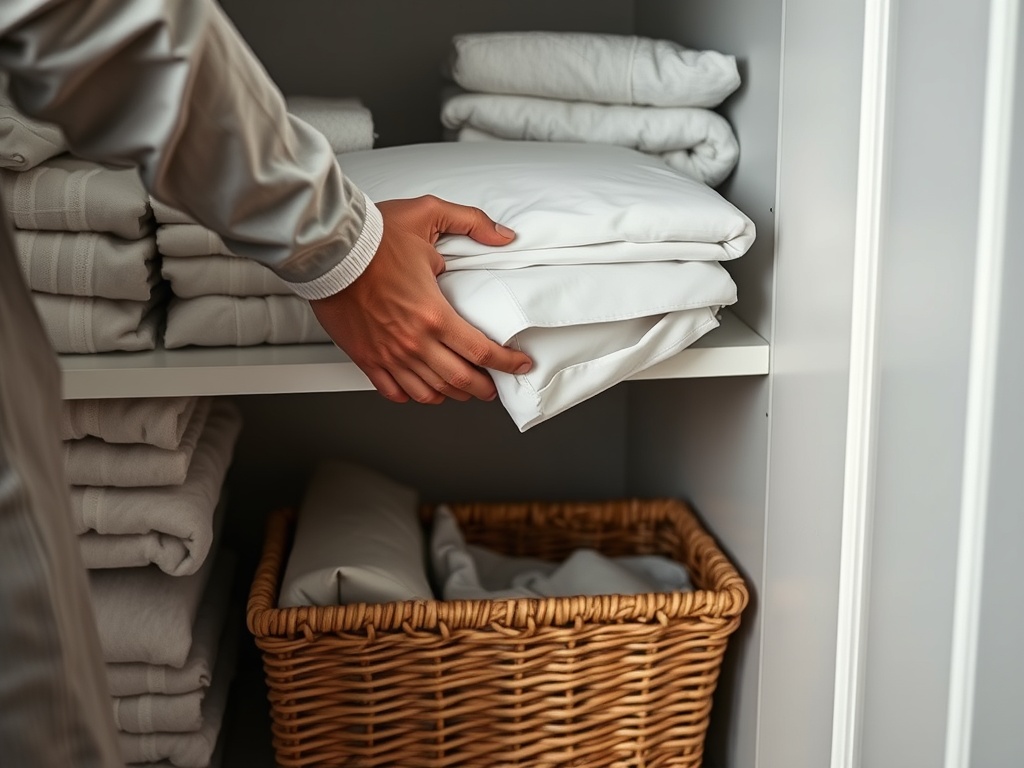
Fold the fitted sheet as neatly as practical, but do not let perfection become the barrier to putting laundry away. Place the fitted sheet, flat sheet, and one pillowcase together; then use the remaining pillowcase as a soft envelope around the set if that method is easy for your household. Another option is to stack complete sets in a labeled basket by bed size.
The key is keeping a complete set together. This prevents the search for a matching pillowcase at bedtime. If several beds use the same size but different linens, a small label on the shelf edge or basket can identify the intended room.
Handle towels and bulky linens without deep-stack problems
Towels can be folded or rolled; the better choice depends on shelf dimensions and how you grab them. A shallow stack often works best on fixed shelves. Rolling can be useful in baskets where each towel remains visible from above. Neither method creates more physical storage space, so choose the one that reduces disturbance during retrieval.
For bulky comforters or guest bedding, breathable fabric bags can contain loose volume and keep sets together. Avoid compressing delicate fill more aggressively than the care instructions allow. Store only clean, fully dry textiles.
Keep a realistic quantity in the closet. If old towels are kept for cleaning, move a limited number to the utility area rather than mixing them with bath linens. The closet becomes faster when each stack has one purpose.
Separate chemicals and child hazards from textiles
Linen closets often become default storage for detergent, cleaning concentrates, medicines, or personal-care products. That mix needs more thought than simple organization. The CPSC Poison Prevention Information Center advises keeping medicines and household chemicals out of children's reach and following safe storage directions, including keeping products in their original containers where appropriate.
Do not decant cleaners into unlabeled decorative jars simply to make a shelf look uniform. Aesthetic consistency is not worth losing safety information. If the closet is accessible to children, use appropriate locked or secured storage for hazardous products and consider relocating them entirely.
Allow ventilation around anything that can retain moisture, and keep towels away from leaking plumbing, damp walls, or wet cleaning tools. If you discover recurring dampness or staining, solve the moisture source before reorganizing the shelf.
Make the system resilient to laundry day
Leave a small amount of empty shelf capacity. If every inch is filled when all linens are clean, the system has no buffer for an extra guest set, a returned load of laundry, or a temporary change in routine. Empty space is part of the design, not wasted space.
Use a one-in, one-out review when buying replacement towels or bedding. This prevents the closet from slowly returning to the same pressure point that caused the reorganization. If an item is too worn for its original use but still useful as a rag, move it immediately to the utility category.
When personal style is also a goal, store the practical bulk here and let only a few intentional textiles appear in the main rooms. The companion guide to personalizing a rental shows how selected fabrics can add character without turning open surfaces into storage.
Judge the closet by how quickly it recovers
A well-organized linen closet should survive an ordinary laundry day. You should be able to put clean items away without rebuilding stacks, hunting for labels, or moving unrelated supplies.
Start by fixing the single slowest retrieval task, such as finding queen sheets or reaching hand towels. Once that route is easy, organize the next category around the same principle: clear location, easy access, and enough space to put items back.
General information note: Home-storage and poison-prevention information is general and educational. Follow product labels, household safety guidance, accessibility needs, and local requirements for storing chemicals, medicines, and other hazards.